Top Sleep Specialist Exposes The $3.1 Billion Truth No Sleep Doctor Says Out Loud: Your CPAP Is A Lifetime Sentence
If you can't sleep with your CPAP and can't stand the thought of wearing it for the rest of your life, you're right to think there has to be another way. A sleep specialist with 22 years behind him reveals the $3.1 billion system that keeps so many people stuck on a machine for life, and the simple nightly device his patients use to fix sleep apnea for good.


⚠️ WARNING: This page expires in 72 hours. After that, the $3.1 billion CPAP industry wins, you stay on the machine for life, and your sleep apnea keeps getting worse while nobody looks at it.
I need you to read this carefully. All of it.
Not because I'm selling you something. But because if you can't sleep with your CPAP, what I'm about to tell you could change the rest of your life.
I don't say that lightly.
I've been treating sleep apnea for over two decades. I've set thousands of patients up on CPAP.
And if you're one of the ones who can't get used to it, I already know your story. Because I've heard it a thousand times.
You were relieved when you finally got diagnosed. You thought you'd be a compliant patient.
Then the machine came home.
You lie there for hours with the mask on and can't fall asleep. You pull it off, and you're out in 2 minutes.

Maybe you've gone through mask after mask at about $100 each. Nasal pillows, a full face mask, a chin strap.
You've turned the pressure down, turned the humidifier up, practiced wearing it in the afternoon while you read.
And every time, someone tells you the same thing: "You'll get used to it."
On the nights it ends up on the floor, the gasping comes back. Waking up with your heart pounding, feeling like someone was holding a pillow over your face.
And somewhere in there, the thought hits you: "Will I have to sleep in this thing for the rest of my life?"
I need you to understand something critical:
Sleeping with a CPAP is not going to get better by "getting used to it".
And this isn't your fault. It's the $3.1 Billion system's fault, which I'll prove to you in 20 seconds.
The $3.1 Billion Secret Nobody Told You

Sleep apnea is a $3.1 billion a year business in the US alone. And almost all of it comes from one thing: keeping you on the machine.
The CPAP was first used on a sleep apnea patient in 1980. More than 45 years later, it's still the same idea: a machine that forces air down your throat all night.
So in 2026, we're still using technology from 1980, and nobody has really gone back and worked out how to actually fix the problem.
Why would they? Every new mask, every cushion, every filter and hose you replace every few months is another sale. A patient on a CPAP is recurring revenue for life.
A patient who gets fixed never buys anything again.
So here's what nobody in my field says out loud: the CPAP was never built to fix your sleep apnea. It was built to manage it, every night, for the rest of your life.
It's also why you haven't heard about what I'm about to show you. It's relatively new compared to CPAP, which has been the standard for decades.
Medical adoption takes time. It took 15 years for CPAP itself to become mainstream.
Many sleep specialists know about it by now, but the referral networks haven't caught up.
And a treatment you use for about 100 nights and then never need again doesn't make anyone money every month.
That's precisely why I'm writing this article: to bridge that gap. Even if some of my colleagues won't thank me for it.
Why I'm Asking You to Take This Very Seriously

I don't write articles like this often.
But I'm genuinely worried about the patients I can't reach from my clinic. The ones who can't sleep with their CPAP, and are scared to sleep without it.
Because here's what happens every night the mask comes off:
→ Your airway closes. Not once. Not twice. Dozens of times per hour, and every time, your brain is starved of oxygen.
→ Your blood pressure spikes with every one of them. Night after night, year after year, it wears down your heart and the small vessels in your brain. In the Sleep Heart Health Study, which followed 5,422 people for about 9 years, men with moderate to severe sleep apnea were nearly 3 times as likely to have a stroke.
→ Your brain pays for it. The fog, the forgetfulness, the afternoons you can barely keep your eyes open. That's not aging. That's chronic oxygen deprivation.
So you're stuck. You can't sleep with the mask. And you know what happens without it.
I'm telling you this not to scare you, but because too many of my patients gave up on the machine and didn't replace it with anything.
By the time they came back, the damage was done.
Please don't be one of them.
What Happens If You Keep "Managing" It

I debated whether to include this section. But I've watched too many patients sit across from me saying "I wish someone had told me sooner."
So I'm telling you now.
This is what managing sleep apnea with a machine you can't sleep with looks like over the years. I've watched it in my practice hundreds of times.
Year 1: The "You'll Get Used To It" Phase
You try a new mask. Then another.
You adjust the settings, buy a chin strap, practice in the afternoons. Some nights you get 2 to 4 hours with it on.
Most mornings you wake up more tired than before you started.
Year 2 to 3: The Hope And Letdown Cycle
Every new mask is a new hope, and a new letdown. The temptation to give up is overwhelming, but you're scared of what happens if you do.
Your blood pressure starts climbing, and your doctor can't figure out why it won't stabilize.

Year 5: The Implant Talk
Your sleep doctor runs out of masks to suggest. "If you can't tolerate it, there's always the implant." $30,000 to $40,000 and surgery.
This is when most of my patients finally ask me if there's anything else.
Year 10+: Still On The Machine
The same mask, the same hose, the same hiss.
Your sleep apnea is worse now than the day you were diagnosed, and you're still serving the same life sentence, one night at a time.
I'm writing this because I'm tired of meeting patients at Year 5 when I could have helped them at Year 1.
Maybe you're somewhere in year 1 to 3 right now. The fact that you're reading this means you still have time.
Please don't waste it.
So What's Actually Causing This?

Here's what I explain to every patient on their first visit:
Your CPAP works. While it's on your face, your airway stays open. But take it off for one night, and your AHI is right back where it started.
Because keeping the airway open isn't the same as fixing it. It just forces air past the problem and never asks why the airway closes in the first place.
That's the question the newer research finally asks. And study after study, scans of thousands of sleep apnea patients keep pointing to the same place:
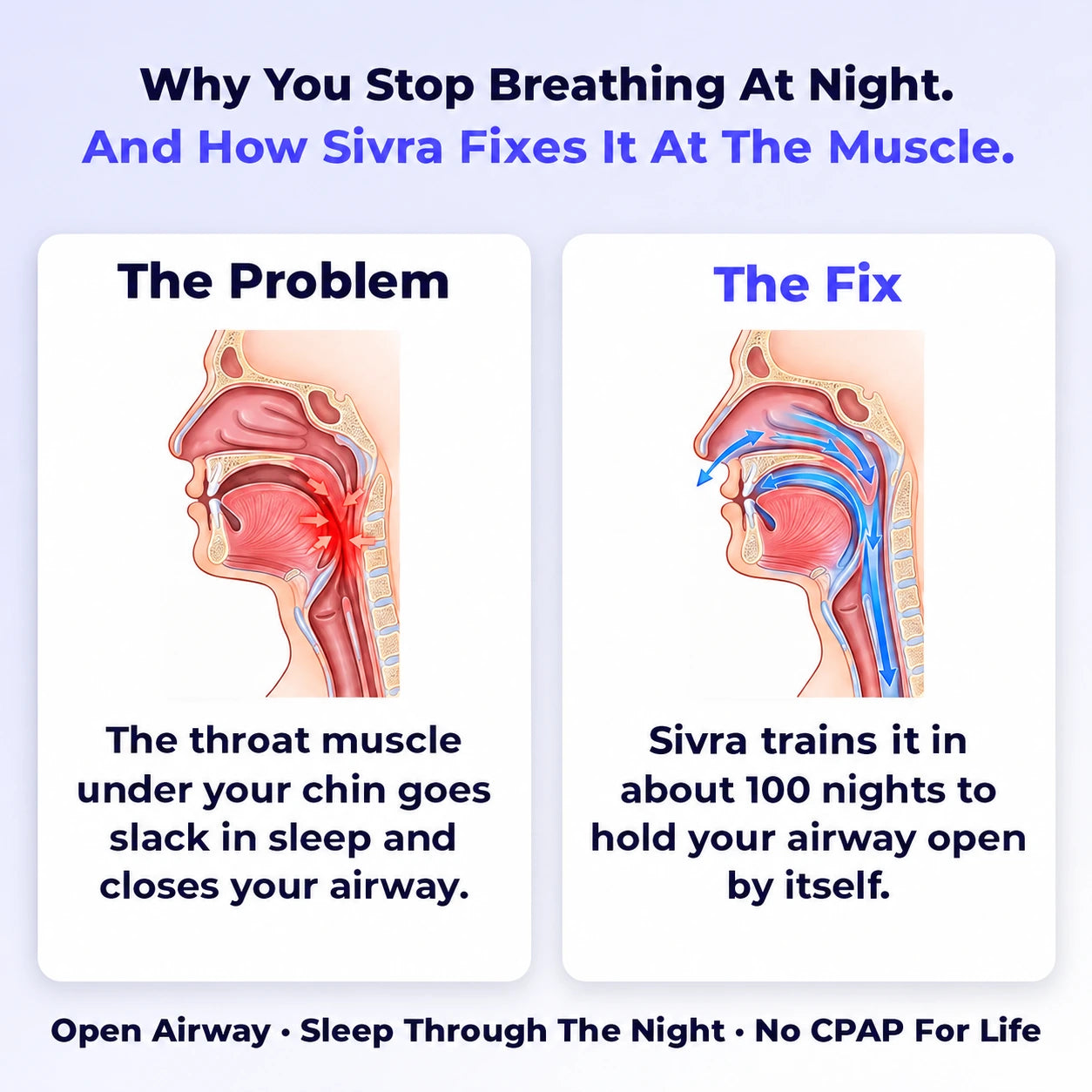
It's a muscle under your chin.
Put 2 fingers right under your chin and swallow. Feel that move? That's it.

Its job at night is to hold your airway open. When you fall asleep, it relaxes.
With sleep apnea, it relaxes too much, sags inward, and your airway closes, over and over, all night.
That's why on the nights you sleep without your CPAP, you wake up gasping for air. Nothing is wrong with your lungs.
That muscle let go, your airway closed, and your brain jolted you awake to get you breathing again.
And like every other muscle in your body, it weakens with age. Your arms aren't as strong as they were at 30, and neither is this one.
Researchers at Harvard Medical School found the same thing: the older we get, the less this muscle reacts to hold the airway open. Which means your sleep apnea gets a little worse every year.
It's also why so many people are told they have "a big tongue" or "a small jaw." This is the muscle that holds your tongue forward at night.
When it goes slack, your tongue falls back into your airway. And the bigger the tongue or the smaller the jaw, the less room there was to begin with.
Narrow airway = snoring.
Blocked airway = sleep apnea.
That's it. That's the entire mechanism.
Now, you might have heard of Inspire, the implant. It's built on exactly this finding: every night it sends a signal to that same muscle so it holds the airway open.
But I'm not going to sell you a $30,000 surgery. Therapists have been training this same muscle from the outside for years. I'll get to that.
So if your airway closes because a muscle goes slack... then more air will never fix it. Only training the muscle will.
And it's the only way to fix it for good without surgery.
And this is exactly why nothing you've tried has worked.
Why Nose Strips, CPAP, and Mouthguards All Failed You

Nose strips, mouth tape, special pillows: they don't touch your throat muscles. They're like putting a bandage on a broken bone.
CPAP machines force your airway open with pressurized air. Technically effective, while it's on your face.
But 50% of patients quit within months because of the claustrophobia, the noise, the discomfort and the cost.
And it never touches the muscle, so the second it comes off, the muscle is no stronger than the day you were diagnosed. That's why they tell you it's for life.
In my clinic, I call CPAP a "medical shackle."
Same with APAP and BiPAP. Different pressure settings, same air, same mask, and they never touch the muscle either.
Mouthguards (MADs) push your jaw forward to open the airway.
But at $2,000 for a custom one, jaw pain, dental shifts, and the fact that you're still dependent on a device in your mouth forever, it's a band-aid, not a cure.
Every single one of these treats the symptom. None of them strengthens the muscle that's actually causing the problem.
None of this was your fault. Nobody told you you'd been treating the wrong problem.
Until now.
The Breakthrough I Wish I'd Found 2 Decades Ago (It Could Have Saved Lives)

I'll be honest with you. When I first heard about Sivra Night Pod, I was skeptical. Another gadget? Another "breakthrough"?
Then I reviewed the clinical data.
It uses neuromuscular electrical stimulation, the same thing speech therapists use on stroke patients to retrain the muscles they swallow with, and physical therapists have used for decades to rebuild weak muscles. A study out of King's College London put it under the chin of sleep apnea patients, and their AHI dropped from 28 to 3.
It's the same principle as the implant. Except it works from the outside, through the skin under your chin, while you sleep.
It's the only way to train that muscle every night without surgery.
If I'd had this 2 decades ago, I could have saved lives. I still think about the patients who gave up on their CPAP and never came back.
So I recommended it to a few patients who couldn't tolerate their CPAP. Then I watched their numbers change.

✓ AHI scores going from 30 to 65 down to 2 to 6.
✓ Patients sleeping through the night with nothing on their face. No CPAP.
✓ Patients telling me they'd finally stopped fighting a mask every night.
In 22 years, it's the only thing I've seen actually fix sleep apnea without surgery.
Then I looked into the company. Sivra Night Pod is the world's first device built to do exactly what those studies did, under the chin, all night, while you sleep.
A team of sleep doctors and engineers spent 2 years taking it from a prototype to a finished device, and the one shipping now is version 4.
It's been on the market for 6 months, and the feedback has been nothing but good. Every other one I've seen since is a copy.
I've now recommended Sivra Night Pod to over 400 of my patients personally.
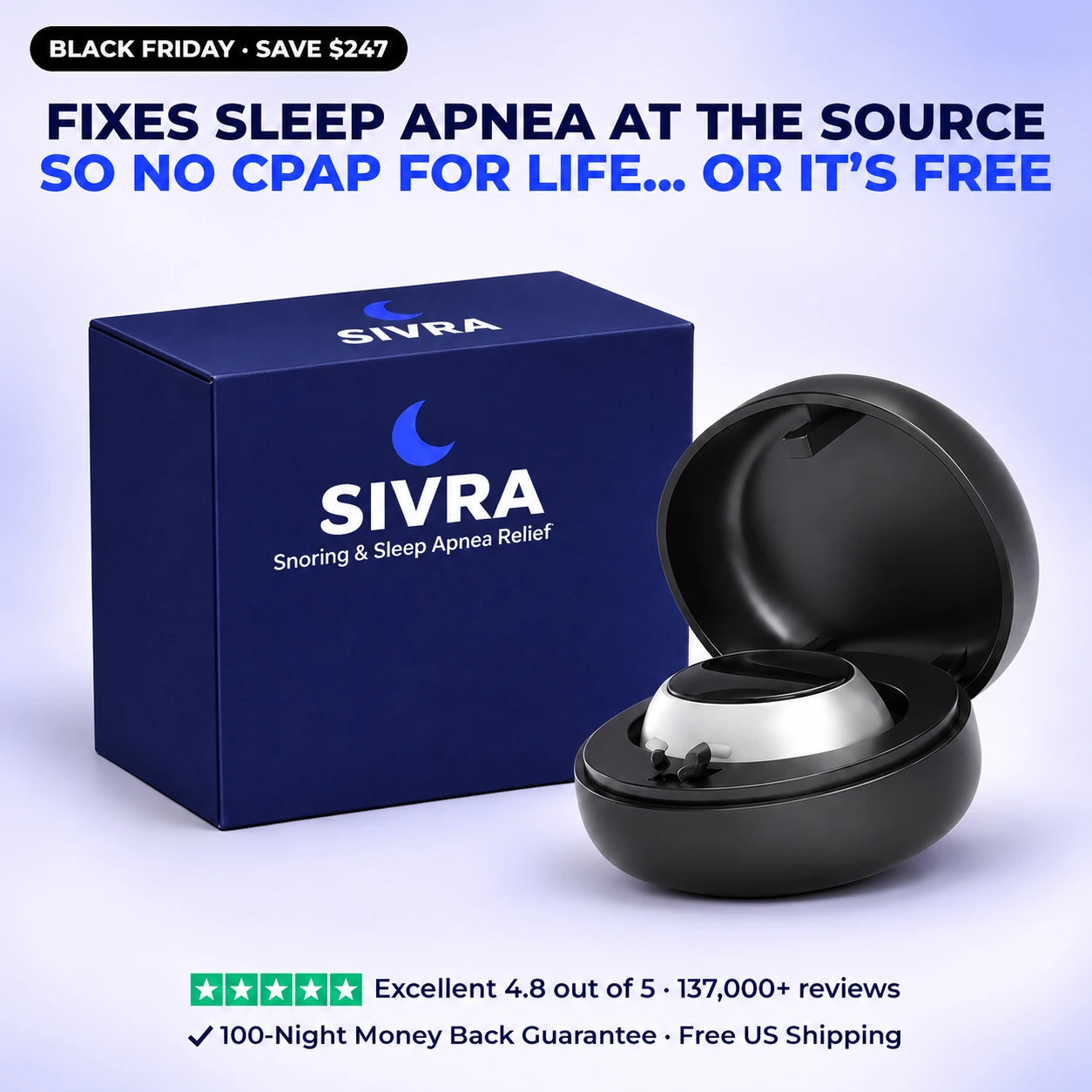
It's the only solution I've found that targets the actual root cause (the weak muscle under your chin) instead of managing it.
But here's what makes it truly different from everything else:
It's not a life sentence.
After 100 days of consistent use, 95% of patients find they no longer need the device. The muscle has been retrained to hold the airway open on its own.
The snoring stops. The apnea resolves.
This isn't managing it for the rest of your life. This is fixing it.
Over 145,000 Americans have already completed it.
How Does It Actually Work? (5 Seconds A Night)
One thing my patients love about Sivra Night Pod is how absurdly simple it is. No setup. No fitting appointment. No mask to get used to.
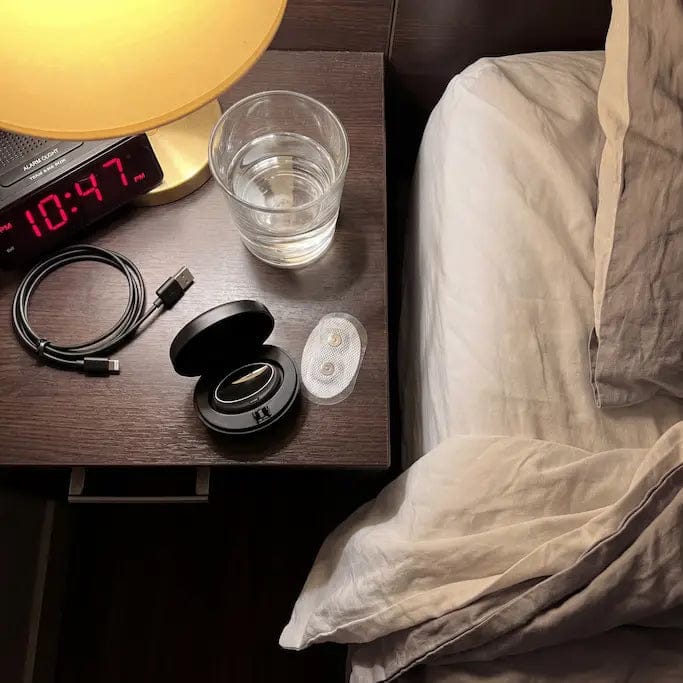
1Peel off the patch and stick it under your chin. Takes 5 seconds.
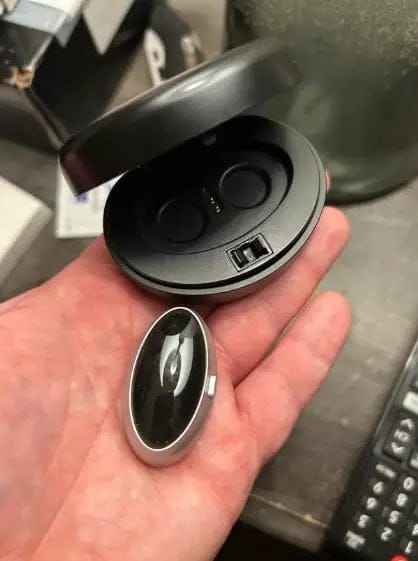
2Attach Sivra Night Pod to the patch. It clicks into place.
3Press the button, select your intensity level (3 levels available), and go to sleep.
That's it.
Sivra Night Pod is wireless and completely silent.
It works automatically throughout the night, sending gentle micro-pulses (EMS) to the muscle under your chin to keep it toned and your airway open.
It stays put even with a beard. And like one of my patients told me, within a minute you forget it's even there.
And here's the part that still surprises me as a doctor:
After 100 days of consistent use, 95% of patients find the muscle has been retrained. It holds firm on its own.
You take it off, and the results stay.
No other solution on the market can say that. Not CPAP. Not mouthguards. Not surgery. Only Sivra Night Pod treats the cause instead of managing the symptom.
What to Expect in Your First 100 Days
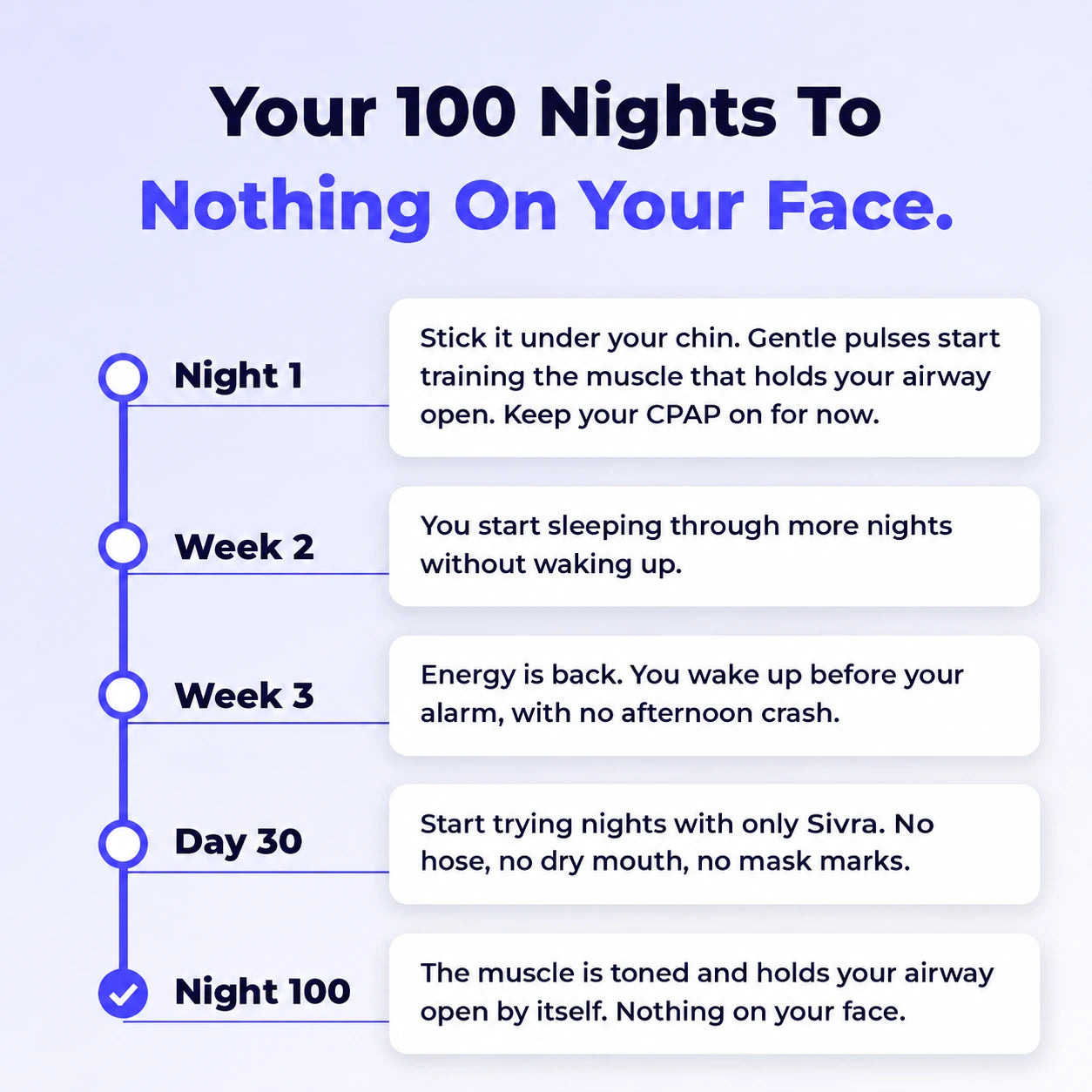
My patients always ask me: "How fast will it work?" Here's what I tell them.
I've now seen it patient after patient, and with over 145,000 people through the program, there's a lot of data behind it.
One thing first. I never tell my patients to throw their CPAP out on night 1. Most wear both for the first few weeks.
But I'll be honest, a lot of them stop using the CPAP somewhere between day 20 and 35, because they're sleeping better with Sivra Night Pod alone.
Night 1 to 3: Falling Asleep Like A Normal Person
For the first time in a long time, you go to bed without dreading it. You stick it on, close your eyes and fall asleep.
No hiss, no seal to fix, no hose to roll over.
Week 1 to 2: Sleeping Through The Night
You wake up and realize you slept straight through without waking up gasping. The heaviness isn't there.
Your brain feels clearer. You have energy at 2 PM instead of crashing.
And your wife tells you the snoring has gone quiet.
Month 1 to 2: The CPAP Goes In The Closet
Somewhere in here, most of my patients sleep their first night with nothing but Sivra Night Pod, and wake up before the alarm. The snoring is gone.
Not quieter. Gone.
You stop thinking about masks, settings and cleaning hoses. You fall asleep with your wife in your arms again, with nothing between you.
On your next trip you pack one bag, and the little device fits in your shirt pocket.

Month 3 to 4: The Permanent Shift
The muscle is now retrained. It holds your airway open on its own.
You start forgetting to put the device on, and realize you don't need it anymore. No CPAP. Nothing on your face. For the rest of your life.
Your next sleep test comes back with a low AHI, and for the first time since your diagnosis, you stop worrying about what your sleep apnea is doing to your heart.
This is the moment my patients walk into my office looking like a different person and ask me: "Why didn't anyone tell me this years ago?"
95% of patients who complete the 100-day protocol no longer need the device. The muscle remembers. The results stay.
What It Costs (Compared To What You're Paying Now)
 BLACK FRIDAY62%
OFF
Before I recommend anything, my patients always ask what it costs. So here's the honest answer.
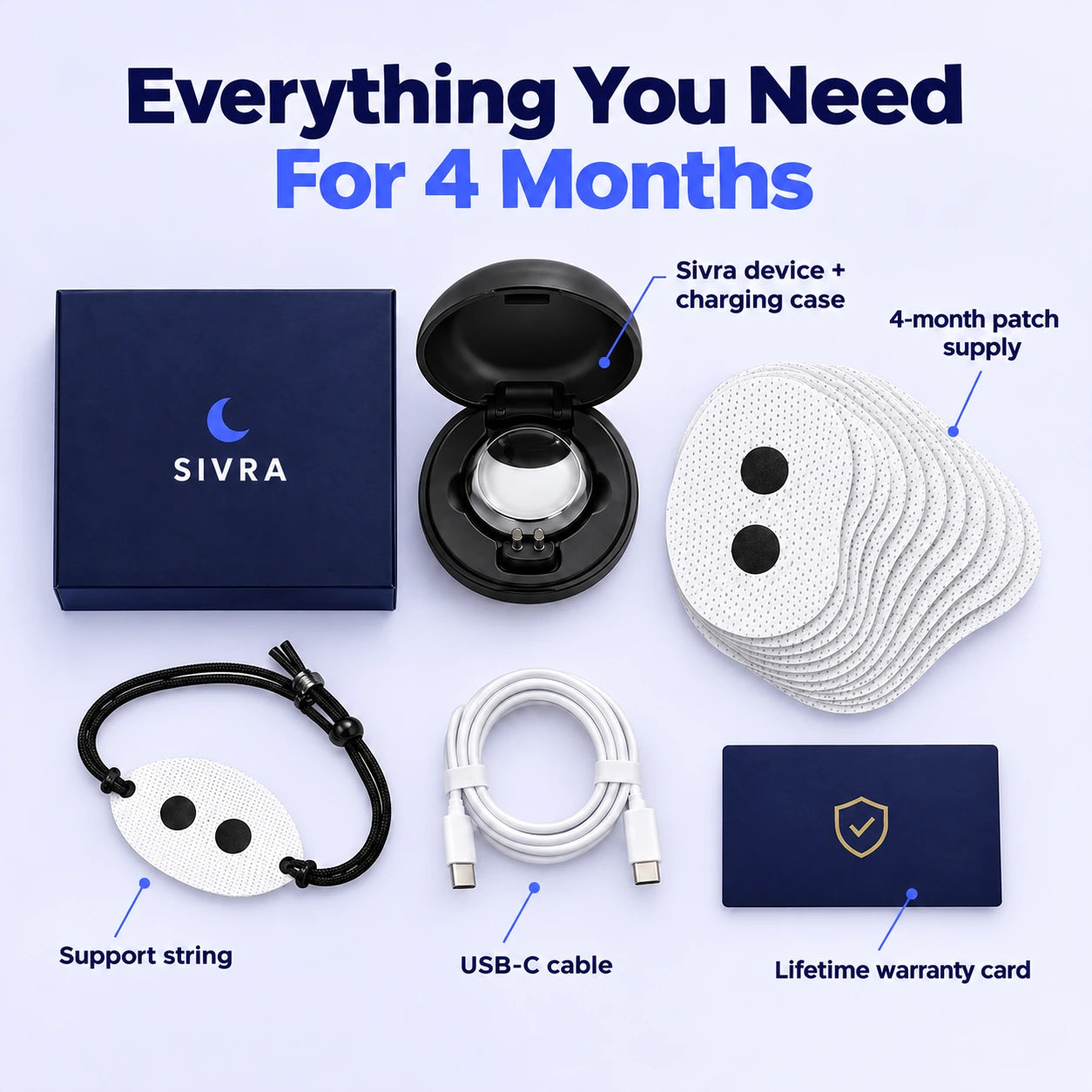
Sivra Night Pod comes as a Complete Treatment Program:
✔ Sivra Night Pod device ($299)
✔ 4 months of patches
✔ Lifetime warranty and VIP support ($69)
✔ Support strap ($19)
✔ Protected shipping ($9)
That's $396 worth.
Now compare that to what you're being told are your options.
A single new CPAP mask runs about $100, and most of my patients who can't tolerate it have been through 3 or 4.
Then there are the cushions, filters and hoses you replace every few months, for the rest of your life.
The implant runs $30,000 to $40,000, plus the surgery.
And for Black Friday, the whole Sivra Night Pod program is $149. Yes, the whole bundle. That's 62% off.
✓ Free Shipping✓ Lifetime Warranty✓ 100-Night Money Back Guarantee
And you only need it for about 100 days, not for the rest of your life.
Why so low? I asked them.
Sivra Night Pod is still collecting results so they can publish a bigger study, and they want as many people as possible to try it and report back.
On day 100, you can send your results to Sivra, and a real person reads it and writes back. Tell them how fast it worked and what your AHI is now.
I'd love for yours to be one of them.
This Black Friday price could end any day now. Word is spreading fast, and stock is limited.
When it ends, it goes back to $396.
You Risk Absolutely Nothing. I Made Sure of That.
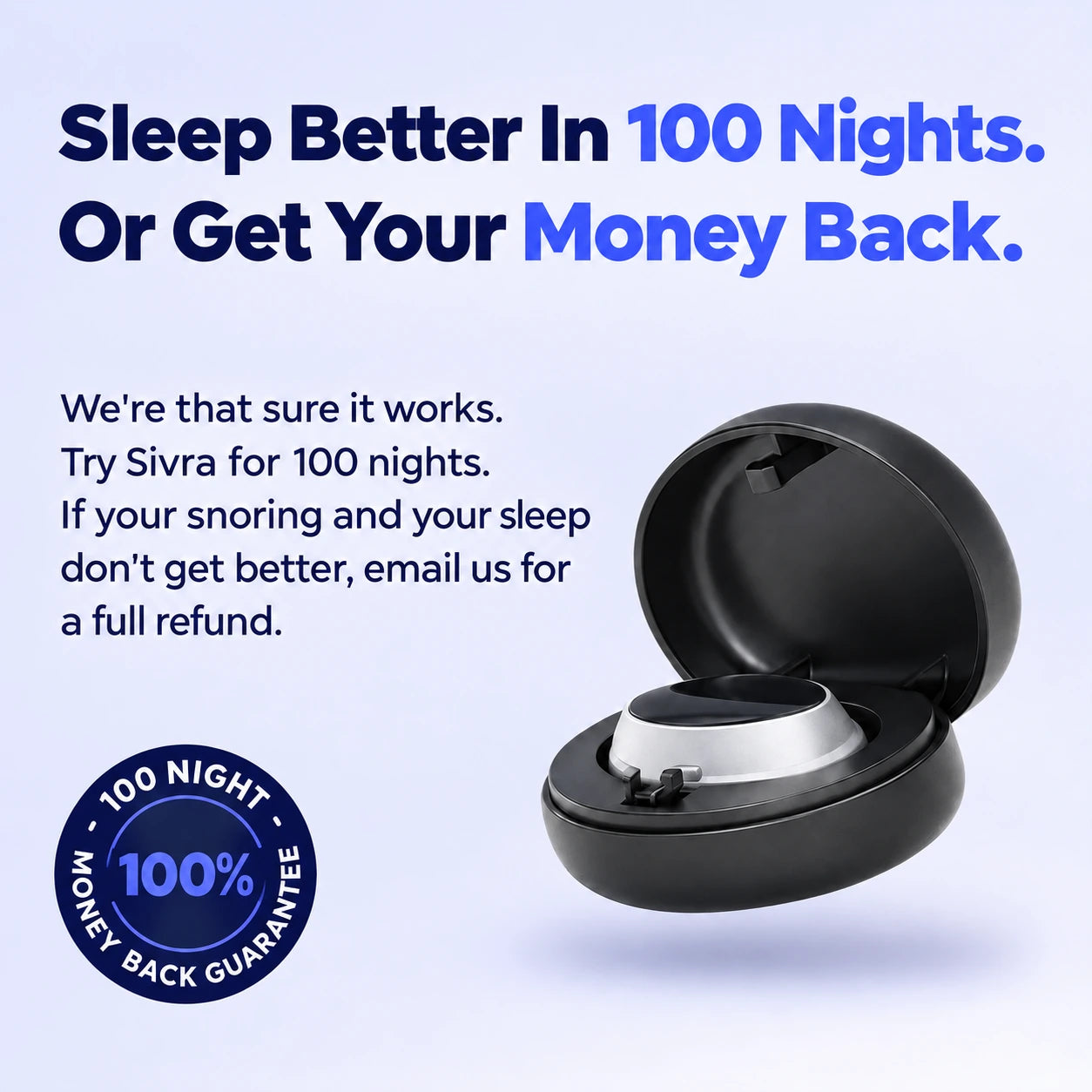
Before I recommend anything to my patients, I need to know they're protected. That's non-negotiable for me.
That's why I specifically asked the Sivra Night Pod team about their guarantee before I ever wrote a single word about them.
Their answer is why I'm comfortable putting my name on this.
You have 100 full days to test it.
Not 30. Not 60. One hundred days, because real muscle re-education takes time, and they want you to experience the full protocol before you judge it.
If after 100 days you're still not sleeping through the night... if your sleep apnea hasn't improved... if you don't wake up feeling like a different person...
You email them. Full refund. You don't even have to send it back. No store credit. No return shipping. A real person answers your email.
In 22 years of practice, I have never seen a company offer that kind of guarantee on a medical device.
I actually asked them how many people take them up on it. Their refund rate is 1.2%. They do it because it works, and they know it.
So let me be clear: the only risk here is another year of fighting the mask.
Try Sivra Night Pod Risk-Free for 100 DaysBlack Friday: $149 (62% off) · Free shipping · 100-night guarantee
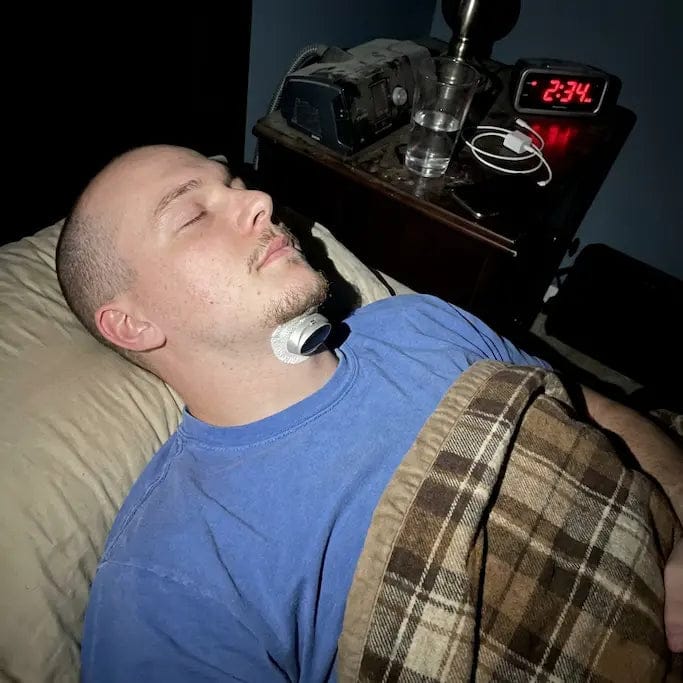
Been on cpap for 6 years and hated every minute of it. The mask leaked, it was loud, couldn't pack it for trips easily. Switched to Sivra Night Pod and its life changing. Why didn't this exist 6 years ago.
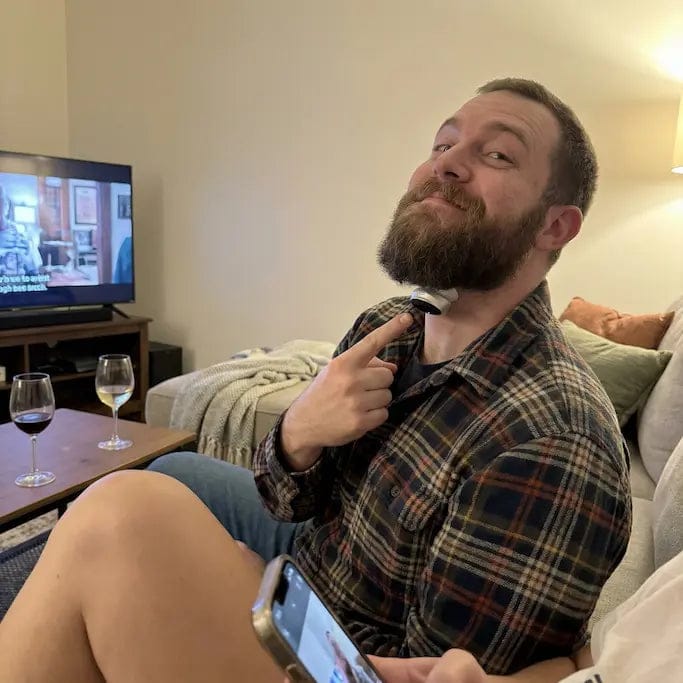
Doctor said I stopped breathing 89 times per hour. That's more than once per minute. Using this for 2 months and down to 12 times. Life changing.
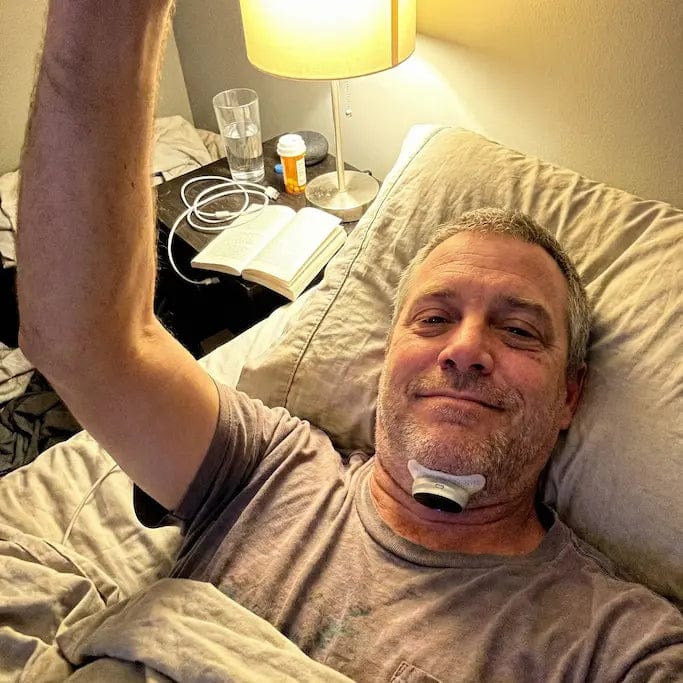
My wife recorded me sleeping and I sounded like I was dying. That video made me order this same day. She says I'm breathing normal now.
Couldn't remember the last time I woke up feeling rested. Maybe college? Got Sivra Night Pod and feel 20 years younger. Actually know what refreshed feels like now.
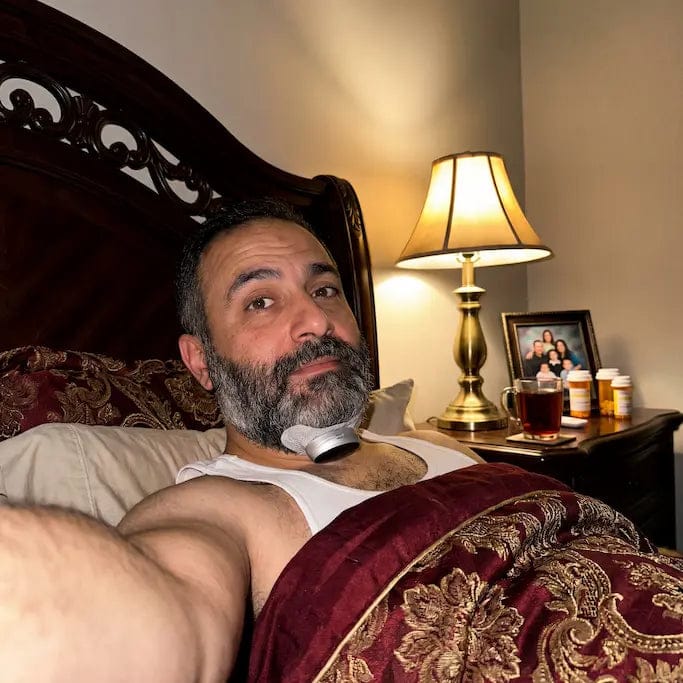
After roughly 2 months my sleep apnea improved dramatically. Actually wake up feeling rested instead of exhausted every morning.
I'll Be Direct With You

In 22 years of practice, I've watched patients who can't tolerate their CPAP go through the same cycle:
Get diagnosed → get a CPAP → can't sleep with it → try another mask → adjust the settings → buy a chin strap → still can't sleep → get told to "get used to it" → think about quitting → too scared to quit → get offered the implant.
Meanwhile their blood pressure climbs, their energy disappears, and their risk of heart attack and stroke quietly increases every single year.
I'm tired of watching it happen.
Sivra Night Pod is the only solution I've encountered that breaks this cycle, because it's the only one that fixes what's actually broken: the muscle under your chin.
It's non-invasive. It's comfortable.
It works while you sleep. And after 100 days, most patients are done.
Their airway stays open on its own. No more machines, masks or mouthpieces. Ever.
I can't force you to take action.
But as a doctor who has seen what happens when people wait, when they tell themselves they'll get used to it for one more year, two more years, five more years, I am asking you:
Don't wait.
Your heart can't wait. Your brain can't wait. And that muscle gets weaker, not stronger, with every year it goes untrained.
If you recognize yourself in anything I've written today, please take the next step.
This is the solution. I've staked my professional reputation on it. And it comes with a 100-day money-back guarantee, so you risk absolutely nothing.
See If Sivra Night Pod Is Right For YouBlack Friday: $149 (62% off) · Free shipping · 100-night guarantee
Questions My Patients Ask Me Every Day
After recommending Sivra Night Pod to over 400 patients, I hear the same questions. Here are my honest answers.
Does it hurt? Will I feel the pulses?
No. The micro-stimulations are so gentle that most patients forget the device is there within two minutes of lying down.
I've had patients with extreme sensitivity try it, and none have reported discomfort. It's nothing like a TENS unit.
Think of it as a barely perceptible hum, far below your pain threshold.
Can I use it while I'm still on my CPAP?
Yes. If your CPAP works for you, keep using it while you train the muscle, then taper as your numbers improve.
Don't stop anything your doctor has you on without asking.
I have severe sleep apnea (AHI 50+). Will this actually work for me?
Yes. In fact, some of the most dramatic results I've seen have been in severe cases.
One of my patients went from an AHI of 68 to under 5 in three months. Severe cases often respond strongly to NEMS therapy because the muscle weakness is so pronounced.
There's simply more room for improvement.
That said, severe cases should not stop any current treatment abruptly. Use Sivra Night Pod alongside your existing treatment, then taper as your numbers improve.
What if I move a lot in my sleep?
The device stays in place. The patch is designed for 8+ hours of movement, and the support strap that comes in your program keeps it in place if you toss and turn.
I've had patients who sleep on their stomach, their side, toss and turn. The device holds.
Does it work with a beard?
Yes. It stays put with a beard. If yours is very thick, trim the small spot where the patch sits.
Is it really permanent? Or will I need it again?
In my clinical observation, 95% of patients who complete the full 100-day protocol maintain their results long-term.
The muscle develops genuine tone, the same way any muscle does after consistent training.
Some patients use the device occasionally as "maintenance" (maybe once a month), but the vast majority are completely device-free after the protocol.
I've tried literally everything. Why would this be different?
Because everything you've tried works around the problem: more air, a different mask, a new jaw position.
None of it strengthens the muscle that's causing the problem.
Sivra Night Pod is the only solution that targets the root cause: the weak muscle under your chin. It's not managing your sleep apnea.
It's retraining your body to fix it.
What if it doesn't work for me?
Then you email them within 100 days and get a full refund. You don't even have to send it back. No questions.
I wouldn't recommend any product that didn't offer that level of protection.
Black Friday: $149 (62% off) · Free shipping · 100-night guarantee

Wife said our relationship was falling apart because of my snoring. Got Sivra Night Pod and things are getting better. Intimacy coming back slowly.
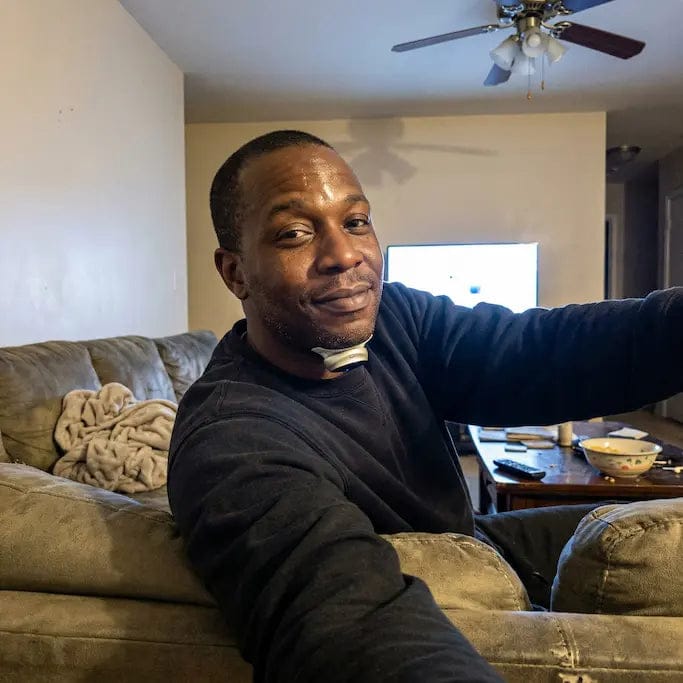
My daughter said all her friends' parents sleep together. Made me realize how abnormal our situation was. Fixed it with Sivra Night Pod. Normal family again.
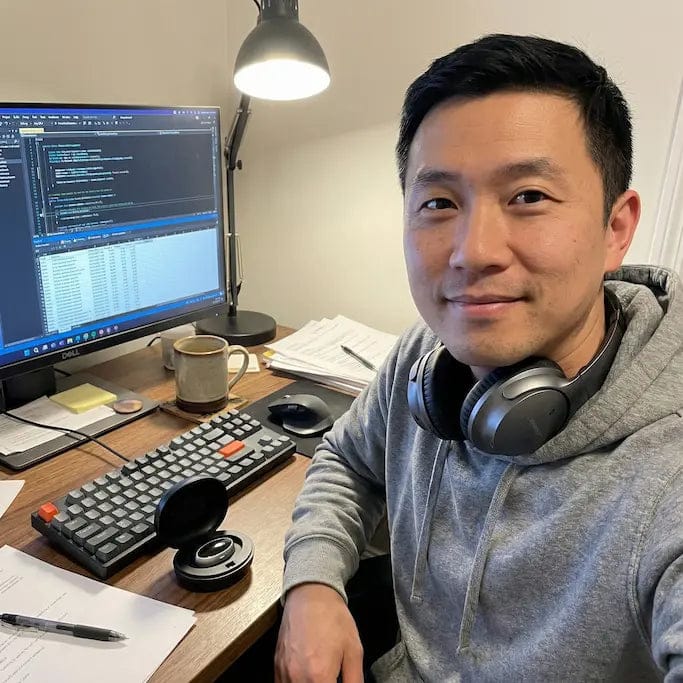
The guilt of being a burden to my wife was terrible. She looked exhausted all the time from my snoring. Finally doing something about it and she's sleeping great now.
My testosterone dropped to 180 and doctor said it's the apnea. Affecting everything in my life. Using Sivra Night Pod for 6 weeks and already feel like a man again.
Dr. Daniel Hartley has been a practicing sleep medicine physician for 22 years. He has treated over 8,000 patients with sleep-disordered breathing. He has no financial relationship with Sivra Night Pod and receives no compensation for this article. He recommends Sivra Night Pod based solely on the clinical results he has observed in his patients.